
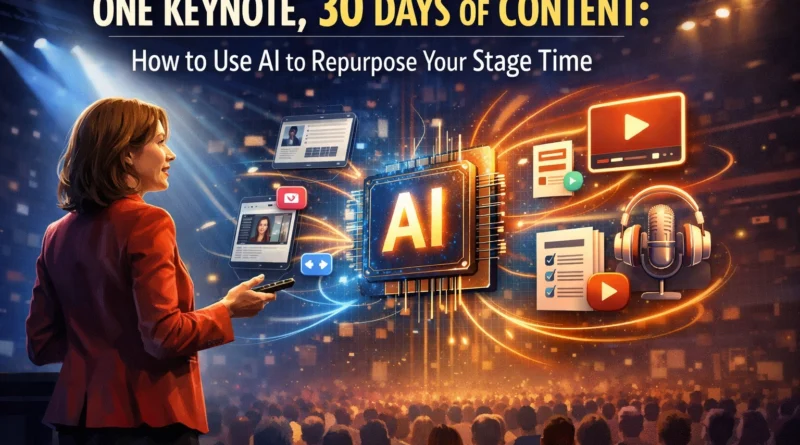
One Keynote, 30 Days of Content: How to Use AI to Repurpose Your Stage Time
You just walked off stage. The applause was loud. You shook some hands, signed a few books, and headed to the airport. You’re waiting for the wire transfer to hit, and you feel good.
But here is the problem: You’re back on the treadmill. To get more bookings, you need more visibility. To get more visibility, you need to post on social media, write a newsletter, update your blog, and keep your LinkedIn feed from looking like a ghost town.
Most speakers hate this part. It’s the "content grind." You spent weeks refining that 45-minute keynote, and now it’s sitting on a hard drive gathering digital dust.
Stop doing that.
That one keynote is not just a speech. It is a 30-day content machine. If you aren't using AI to slice it, dice it, and distribute it, you are working too hard for too little return. At The Stage & Page AI Lab, we teach the S.T.A.G.E. System, and a huge part of that is Automation and Engagement.
Here is exactly how you take one keynote and turn it into a month of authority-building content without breaking a sweat.
The Raw Material: Your Keynote is a Goldmine
Every keynote has a structure. You have your opening hook, your three to five main pillars (points), your stories, and your closing call to action.
If you talked for 45 minutes, you likely spoke about 6,000 to 7,500 words. That is more than enough for a short book, ten blog posts, or fifty LinkedIn updates.
The first step is simple: Record everything. If the event didn't record you, set your phone up on a tripod at the back of the room. The audio is the asset.
Step 1: The AI Transcription (The Foundation)
Don't hire a human to transcribe this. It takes too long and costs too much. Use an AI tool like Otter.ai or Descript (or use Castmagic to turn your audio/video into clean text you can actually work with). Within minutes, you have a text file of your entire speech.
Now, don't just copy and paste that mess. Transcripts are full of "umms," "ahhs," and "you knows." This is where you feed that transcript into a Large Language Model (LLM) like ChatGPT or Claude.
The Prompt: "I am a professional speaker. Below is a transcript of my keynote. Clean up the filler words, maintain my voice, and organize the content into five distinct pillars or themes."

Step 2: Create Your Pillar Content
Once you have your pillars, you have your "Big Rocks." These are your long-form blog posts.
Take each of those five pillars and tell the AI to expand them into a 1,000-word article. Since the AI is using your words from the transcript, the content will actually sound like you. It won't be generic AI fluff because the "seed" data came from your brain.
By the end of this step, you have:
- 5 High-quality blog posts for your website.
- 5 Newsletters for your email list.
- A foundation for an eBook or a lead magnet.
Step 3: Vertical Video (The High-Impact Clips)
Video is the highest-leverage content you have. But nobody is going to watch a 45-minute video on Instagram. They want the 60-second "Aha!" moment.
In the old days, you had to hire a video editor. You’d pay them $500 to find "the good parts." Now, you use tools like OpusClip or Munch—and when you want to turn those clips (or the full keynote) into usable written assets fast, run the audio/video through Castmagic.
You upload your keynote video. The AI analyzes the sentiment, the crowd reaction, and the punchlines. It automatically crops the video to vertical (9:16), adds captions, and gives you a "virality score."
In 10 minutes, you can have 10-15 high-quality "reels" or "shorts."

Step 4: The Social Media Slicer
Now we need the daily stuff. The LinkedIn posts, the X (Twitter) threads, and the Facebook updates.
This is where Automation in the S.T.A.G.E. System pays you back. Build a simple workflow in Make to auto-pull new assets (clips, captions, blog drafts) into your content hub, then push the final approved posts into your scheduler. And if you want your content distributed across every platform without manually uploading the same file 12 times, plug in Repurpose.io for automated social media distribution.
Take one of your blog posts from Step 2 and feed it back into the AI.
The Prompt: "From this blog post, create 5 LinkedIn updates. Make one a controversial opinion, one a 'how-to' list, one a personal story, one a short tip, and one a 'stop doing this' warning. Use a direct, casual tone."
Repeat this for all five pillars. Suddenly, you have 25 social media posts. That’s five posts a week for five weeks.
The S.T.A.G.E. System in Action
This isn't just about being "busy" on social media. It’s about the S.T.A.G.E. System:
- S – Strategy: You aren't posting random memes. You are posting your proprietary methodology.
- T – Tracking: Use AI to see which of these clips gets the most engagement. Double down on that topic for your next speech.
- A – Automation: This whole process: from transcription to social posts: should be a workflow, not a manual chore. (That’s exactly what tools like Make and Repurpose.io are for.)
- G – Growth: By being everywhere at once, you stay top-of-mind for event planners.
- E – Engagement: When people comment on your "Stage Clips," you talk back. That builds the community that buys your books.

The 30-Day Distribution Plan
Stop thinking about what to post today. Follow this calendar instead:
Week 1: The Big Picture
- Monday: Pillar 1 Blog Post + Newsletter.
- Tuesday: Video Clip 1 (The Hook).
- Wednesday: LinkedIn Post (Personal Story).
- Thursday: Video Clip 2 (The Solution).
- Friday: X Thread (Breaking down Pillar 1).
Week 2: Deep Dive into Pillar 2
- Monday: Pillar 2 Blog Post + Newsletter.
- Tuesday: Video Clip 3.
- Wednesday: LinkedIn Post (The Mistake People Make).
- Thursday: Video Clip 4.
- Friday: X Thread (Pillar 2 steps).
Repeat for Weeks 3 and 4.
By the end of the month, you have published 4 long-form articles, 4 newsletters, 8-10 high-quality videos, and 20+ social media updates.
And remember: You only did the work once. You gave one speech. The AI did the heavy lifting of turning that speech into a marketing campaign.

Why This Matters for Your Bottom Line
Most speakers are "one and done." They speak, they leave, they wait for the next gig.
But when you repurpose your content, you are building an ecosystem.
- An event planner searches for a topic on LinkedIn and sees your video.
- A podcast host reads your blog post and invites you on their show.
- A potential client signs up for your newsletter because your X thread was helpful.
This is how you move from being a "speaker" to being an authority. Speakers have to pitch for work. Authorities have people sliding into their DMs asking for their availability and fee schedule.
Stop Being the Bottleneck
The biggest reason speakers don't do this is because they think they have to do it themselves. They think they need to be the writer, the editor, and the social media manager.
You don't.
Your job is to be the source. Your job is to stand on that stage and deliver the brilliance. The AI is your "Invisible Staff." It takes your brilliance and clones it.
If you aren't using AI to repurpose your stage time, you aren't just losing time: you're losing market share.
Final Thoughts
The technology is here. The tools are cheap. The only thing missing is your commitment to stop wasting your best material.
Take that video from your last gig. Get it transcribed. Put it through the ringer. See what happens when you actually show up in people's feeds every day with high-value content that you already wrote.
This is the Business Blueprint way. Work once, profit forever.
If you want to see exactly which tools we use to make this happen, or if you’re ready to implement the full S.T.A.G.E. System in your speaking business, you know where to find us.
Now, go find that video file and get to work. Your 30 days of content are waiting for you.